While the exact mechanisms are still debated in sports science, exercise-associated muscle cramps (EAMC) generally stem from a combination of three main physiological failures.
1. Altered Neuromuscular Control (The Fatigue Theory)
This is currently the leading scientific consensus for most localized cramping. When a muscle becomes severely fatigued, the local neural controls begin to misfire, disrupting the balance between excitation and inhibition.
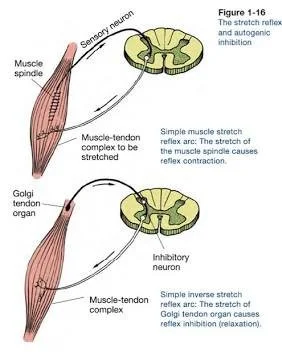
Spindle vs. Golgi tendon reflex arcs. Source: ACE Fitness
Fatigue causes an imbalance between two key proprioceptors:
Muscle Spindles: Located within the muscle belly, these detect stretch and send signals that excite the muscle to contract. Extreme fatigue makes these receptors hyperactive.
Golgi Tendon Organs (GTOs): Located at the muscle-tendon junction, these detect tension and send signals to inhibit contraction to prevent structural damage. Fatigue depresses GTO activity.
When the spindles fire on overdrive and the GTOs stop sending their protective inhibitory signals, the result is an uncontrolled, sustained alpha motor neuron discharge—locking the muscle into a cramp.
2. Electrolyte Depletion and Dehydration (The Sweat Theory)
The classical model for cramping revolves around the loss of body water and sodium. During sustained efforts, significant sweating reduces the interstitial fluid volume surrounding the muscle cells.
Muscle contractions are driven by action potentials that rely on precise gradients of electrolytes (sodium, potassium, calcium, and magnesium). Sweating out large amounts of sodium disrupts this osmotic balance. The resulting fluid shifts can sensitize the nerve endings, making the muscle membrane hyperexcitable and prone to spontaneous, full-body cramping rather than just localized twitches.
3. Exceeding Metabolic Conditioning (Overexertion)
Cramping is highly correlated with athletes pushing beyond their current physiological thresholds—competing at a pace, load, or duration that exceeds their actual metabolic conditioning.
When athletes push deep into their lactate threshold for extended periods without the aerobic base to clear the accumulation of metabolites, muscle fibers deplete ATP faster than it can be synthesized. Because ATP is actually required for the myosin cross-bridges inside the muscle fiber to detach from the actin filaments, a localized energy crisis prevents the muscle from relaxing. This rapid depletion is drastically accelerated in hot, humid environments, where the body diverts blood flow away from working muscles to the skin for cooling, reducing oxygen delivery and accelerating fatigue.